Author: Rosalía Sanchez

  • Students on the FLC’s Intermediate Vocational Training Course in Construction are sealing their first building as part of the project

    Students on the FLC’s Intermediate Vocational Training Course in Construction are sealing their first building as part of the project

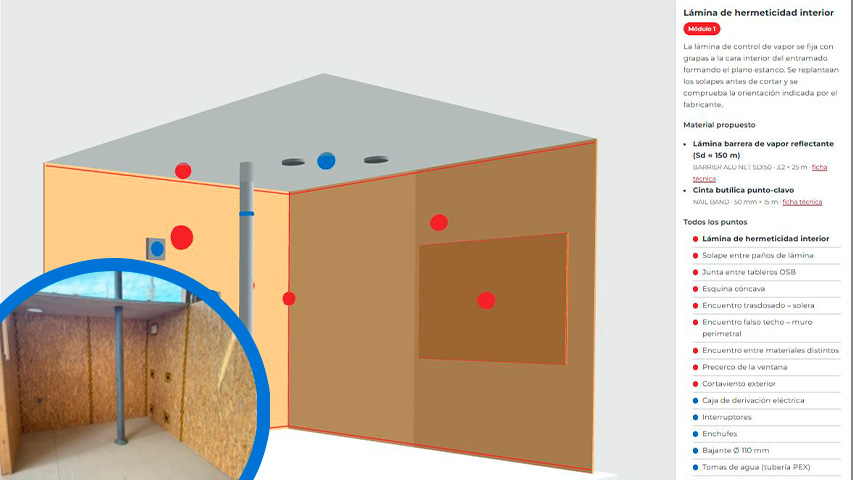
    The pilot run of the Construction Blueprint 2 airtightness course concluded on 9 October in Villanueva de Gállego. Over the course of five weeks, the students built their own light-frame timber structures and practised dealing with the same joints and service penetrations they will encounter on site, using an interactive 3D model to identify critical points in the building envelope.

    It is one thing to understand the theory of airtightness and quite another to achieve a continuous seal with one’s own hands. During the pilot course ‘Applying insulating strips to prevent air exchange between the exterior and interior via suspended ceilings and insulating cladding’, the students faced precisely this challenge: sealing the joints between different materials and then checking whether the result achieved its objective.

    The Aragón Regional Council of the Construction Labour Foundation (FLC) has concluded this practical training on airtightness of the building envelope, as part of Construction Blueprint 2, the Strategic Alliance for Skills Development under the Pact for Skills in the construction sector.

    Five weeks, two modules and a unit built from scratch

    The course was designed to last approximately 8 hours. During the pilot phase, it proved necessary to extend the scope of the work to include the assembly of the light timber frame (OSB3) panel boxes on which the practical exercises were carried out – a decision that proved to be one of the highlights of the experience: the students were not provided with a finished structure, but instead built the very structure they then had to seal.

    The assembly took place in mid-September, and the theoretical and practical sessions for the two modules were held between 17 September and 9 October, the date of the final review and assessment session by the students and trainers. Eleven students took part in the pilot scheme, organised into teams of two or three, with one team per box.

    The training was delivered face-to-face, in classrooms and workshops, with access to an online platform containing all the theoretical content.

    From theory to the critical point: an interactive 3D model

    The course was developed by Ana González and Teresa Sandiumenge, from the headquarters of the Construction Labour Foundation, and was delivered by trainers from the Aragon Regional Council: Juan Lobaco, Lourdes Carreras, Óscar Llorente and Javier Buil.

    As an innovative feature, the team has developed an interactive three-dimensional model of the units in which students can rotate the model, locate each critical point on the building envelope and check, for each one, what type of solution is appropriate and why. The model distinguishes between linear junctions between wall surfaces and service penetrations – the two main sections into which the course is organised – and is available upon registration on the course platform.

    Educational ‘boxes’ featuring real-life construction site problems

    Each of the four boxes, constructed from lightweight timber-framed panels (OSB3), was equipped with the elements that cause the most headaches on a building site: wooden frame, junction box, switches, sockets, washbasin drain, water outlets with PEX pipework, downpipe and light fittings. Using these, the students tackled the most common joints in the building envelope and service penetrations using sealing tapes, strips and membranes.

    The assessment was not limited to the outcome of the waterproofing. The assessment grid used by the trainers covers ten learning outcomes per module, where, in addition to the technical aspects, other factors are assessed, such as the tidiness and cleanliness of the workstation, end-of-day procedures, teamwork, adherence to health and safety instructions, and the management of waste generated. Impeccable sealing with a messy workstation does not pass, just as it would not pass on a building site.

    Pilot programme results

    All eleven trainees passed the training course, which was assessed through theoretical tests and the observation checklists completed during the practical sessions.

    When asked about their level of satisfaction during the final session, the trainees agreed on two points: that putting what they had learnt in the theory into practice is crucial for consolidating their learning, and that having access to the online platform with the theoretical content allowed them to review on their own anything that had not been clear to them in class.

    What those who attended the workshop had to say
    “Taking part in this project on sealing and tape installation has enabled us to learn about materials and application techniques that, until now, we’d only seen in photographs. Assembling the box first and sealing it afterwards changes the way you understand it: you see where the problem lies before it’s explained to you. And it’s a field that’s very important right now, because energy efficiency and cost savings are being discussed on every building site.
    “The construction industry today needs professionals who are trained and equipped to adapt to a labour market where new construction systems are emerging every day. Taking part in these projects enables us to update our teaching staff’s knowledge and enhance our students’ professional skills. What interests me most about this pilot scheme is that the student hasn’t learnt how to install a specific product, but rather how to read a technical data sheet, choose the right solution for the situation at hand and justify why. That skill will serve them well with whatever material they’re given in ten years’ time.”


  • Pact for Skills Newsletter – Fourth Edition

    Pact for Skills Newsletter – Fourth Edition

    The fourth issue of the Pact for Skills Newsletter was published in September 2026, highlighting new initiatives, training opportunities and developments in green and digital skills for the construction sector.   

    Among the key topics covered:

    Construction Blueprint 2 – Launch of a new Facility Energy Management training programme focused on energy efficiency, smart buildings and BIM.     

    Fair Labour Mobility Package – New EU measures to facilitate the recognition and portability of professional qualifications across Europe.     

    Drone4Build – Strengthening drone skills forthe future of construction sector  

    BuildSkills Academy Workshop in Brussels – Pact Coordinators present the Pact for Skills in Construction     

    SUM4Re webinars series – Digital Building Data & Material Passports for Circular Construction

    TRAIECT Just Transition Project – Reskilling Workers to Tackle Labour Shortages in Galați, Romania

    Read the full Newsletter: Pact for Skills in Construction – September Newsletter

  • The BUSUnited project addresses gender balance in the construction sector

    The BUSUnited project addresses gender balance in the construction sector

    The BUSUnited Community of Practice 7 (CoP7) organised the webinar “Gender balance in the design and construction industry” on 16 September, bringing together European stakeholders to discuss women’s participation in the construction sector and share initiatives aimed at promoting a more inclusive workforce.

    The event addressed the challenges faced by the sector in attracting and retaining new talent, at a time when the construction industry is experiencing labour shortages and growing skills needs linked to the green and digital transitions. The webinar focused on practical experiences and initiatives covering training, access to employment, career development and the attractiveness of the sector for women.

    The programme featured several European initiatives, including Women Can Build, presented by Beatriz Oliete, Head of International Projects at Fundación Laboral de la Construcción. Other contributions included the Construction Women of the Year Award in Sweden, Women Empowered in Construction, Boss Ladies in Denmark and the Women in Digital – WIDCON Index & Scoreboard. The presentations were followed by a panel discussion and a Q&A session.

    The webinar also highlighted the importance of connecting gender equality with skills development. This is closely aligned with the objectives of Construction Blueprint 2, which is working to address current and future skills needs in construction and promote a more inclusive and attractive sector. The project has specifically highlighted the importance of attracting new talent, including women and young people, as part of the transformation of the European construction workforce.

  • BuildSkills Academy Masterclass Strengthens Cooperation with the Pact for Skills in Construction

    BuildSkills Academy Masterclass Strengthens Cooperation with the Pact for Skills in Construction

    The BuildSkills Academy Centre of Vocational Excellence (CoVE) brought together leading European experts, policymakers, vocational education and training providers, industry representatives and social partners in Brussels for its first international Masterclass, hosted by the European Construction Industry Federation (FIEC). The event, entitled “The Pact for Skills and what new skills will drive the twin transition?”, focused on the skills transformation required to support the green and digital transition of Europe’s construction sector.

    Organised within the framework of EU Green Week, the Masterclass highlighted the growing importance of collaboration between BuildSkills Academy and the Pact for Skills in Construction, one of Europe’s flagship initiatives for workforce development. The event was co-organised with FIEC, which serves as a coordinator of the Pact for Skills in Construction together with the European Federation of Building and Woodworkers (EFBWW) and the European Builders Confederation (EBC).

    The two-day programme explored emerging skills needs driven by decarbonisation, digitalisation and industrial transformation. Participants exchanged experiences on labour market intelligence, innovative training approaches, certification systems, apprenticeships, lifelong learning and large-scale upskilling and reskilling pathways for construction professionals.

    A key focus of the discussions was the role of the Pact for Skills in mobilising stakeholders across Europe to invest in vocational education and workforce development. The Pact promotes stronger partnerships between industry, education providers, social partners and public authorities, helping to anticipate future skills needs and accelerate the delivery of training opportunities across the construction ecosystem.

    The Masterclass also demonstrated the strong alignment between the objectives of BuildSkills Academy and the Construction Blueprint 2 initiative. While BuildSkills Academy is developing a European framework for certification and upgrading green and digital skills in the built environment, Construction Blueprint 2 is working to develop strategic approaches, curricula and training solutions under the Pact for Skills framework. Together, these initiatives contribute to a more resilient, competitive and future-ready construction workforce across Europe.

    Through this collaboration, BuildSkills Academy and the Pact for Skills in Construction are helping to strengthen the European skills ecosystem, ensuring that workers, companies and training providers are equipped to meet the challenges and opportunities of the twin transition. The Brussels Masterclass marks an important milestone in building a shared European vision for skills development and reinforcing cooperation across the construction value chain.

  • Construction Blueprint 2 at IC2 Congress: advancing innovation and future skills in the construction sector

    Construction Blueprint 2 at IC2 Congress: advancing innovation and future skills in the construction sector

    Last week, Construction Blueprint 2 took part in the first edition of the Innovation Industry Construction Congress (IC2), held on 4 June, providing a valuable platform to foster international networking, strengthen collaboration among key stakeholders, and promote new innovation opportunities across the construction sector.

    Over several days, the congress brought together companies, technology centres, universities, public authorities, and industry organisations to discuss the key challenges shaping the future of construction. Topics addressed included industrialisation, digitalisation, artificial intelligence, sustainability and decarbonisation, innovation in materials, and talent management.

    In addition to encouraging the exchange of knowledge and experiences, the programme featured a wide range of presentations and panel discussions focused on knowledge transfer and the practical application of innovation within the sector.

    In this context, Construction Blueprint 2 participated as a speaker in the session “Strategic Challenges for the Construction Sector: Shaping the Future through Innovation”. The presentation was delivered by Coral Sánchez, International Projects Technician at Fundación Laboral de la Construcción, who shared the main findings of the Urgent Skills Needs Report developed within the framework of the project.

    The session provided an opportunity to present companies and sector stakeholders with an up-to-date overview of the skills needs identified in Spain, alongside a comparison with broader European trends, highlighting the importance of anticipating the competencies required for the future construction workforce.

  • Pact for Skills in Construction: On-line signatory meeting October 2025

    Pact for Skills in Construction: On-line signatory meeting October 2025

    On Thursday, 23rd of October, the Pact for Skills in Construction held an online signatory meeting, bringing together key stakeholders from across the sector. The gathering featured updates from the initiative’s coordinators the European Construction Industry Federation (FIEC), the European Federation of Building and Woodworkers (EFBWW), and the European Builders Confederation (EBC) alongside its signatories. The meeting centered on presenting activities, good practices, and resources dedicated to upskilling and reskilling within the construction sector.

    A highlight of the meeting was a presentation by Eurofound of its latest report on the green and digital transitions shaping the construction industry. Beyond this, the event served as a valuable forum for signatories to share recent initiatives and news with the broader community, fostering exchange and collaboration across the sector.

  • Pact for Skills Newsletter — Third Edition

    Pact for Skills Newsletter — Third Edition

    The third issue of the Pact for Skills Newsletter was published in April 2026, bringing together updates from the coordinators of the Pact for Skills in Construction, the European Construction Industry Federation (FIEC), the European Builders Confederation (EFBWW) and the European Builders Confederation (EBC) and its signatories. The edition highlighted the latest initiatives, ongoing projects, and emerging opportunities shaping the construction sector.

    Among the key topics covered:

    Construction Blueprint 2 Meeting – Updates from thethird Transnational project meeting held in Brussels.

    Pact for Skills in construction Survey – Launch of the Pact for Skills in construction survey for signatories.

    EU Employment and Social rights Forum – News form the annual gathering under the EU Employment and Social rights Forum 2026.

    INSIDE CoVE project meeting – INSIDE CoVE Annual Project Meeting in Germany: EBC Highlights Pact for Skills in Construction.

    EU-projects in Green skills in construction – News from The Green Circle project, Build Your Future with the development of Micro-Credentials in Construction. Policy Recommendations from the BIM4D Project. Building trust in green and digital skills for construction professionals: The Buildskills Academy Certification System.

    Masterclass opportunity – BuilSkills Academy CoVE is organising “The Pact for Skills and what new skills will drive the twin transition?” masterclass in Brussels.

    Stakeholder meeting in Slovenia – Construction sector facing new challenges, Key insights from stakeholder meeting on skills and competencies in Ljubljana.

    Read the full Newsletter: Pact for Skills in Construction – April Newsletter

  • Pact for Skills Newsletter — Second Edition

    Pact for Skills Newsletter — Second Edition

    The second issue of the Pact for Skills Newsletter was published in December 2025, bringing together updates from the coordinators of the Pact for Skills in Construction, the European Construction Industry Federation (FIEC), the European Builders Confederation (EFBWW) and the European Builders Confederation (EBC) and its signatories. The edition highlighted the latest initiatives, ongoing projects, and emerging opportunities shaping the construction sector.

    Among the key topics covered:

    BuildSkills Academy — Introducing a platform to support VET providers in the Green and Digital Transition.

    European Partnership for Affordable Housing Initiative (SHAPE II) – Official call launch for SHAPE II Lighthouse districts in sustainable and affordable housing.

    BUSUnited Project – Official launch of the BUILD UP Skills United project under the LIFE Programme.

    Eurofound Report – Launch of the new Eurofound report on the twin transitions in the construction sector.

    Digital and Green Skills – News on signatory PEDMEDE, actions to strengthen Digital and Green Skills Across Europe.

    Welcome Work Project – Release of Key resources in the framework of The Welcome Work Project on inclusion of refugees within the construction sector.

    Construction Education in Slovenia – Initiatives from the Slovenian Chambers of Construction and Building materials Industry on strengthening cooperation for the future of Construction education.

    Read the full Newsletter: Pact for Skills in Construction Newsletter

  • Pact for Skills Newsletter — First Edition

    Pact for Skills Newsletter — First Edition

    The inaugural issue of the Pact for Skills Newsletter was published in September 2025, bringing together updates from the coordinators of the Pact for Skills in Construction,  the European Construction Industry Federation (FIEC), the European Builders Confederation (EFBWW) and the European Builders Confederation (EBC) and its signatories. The edition highlighted the latest initiatives, ongoing projects, and emerging opportunities shaping the construction sector.

    Among the key topics covered:

    First Signatory Meeting — A recap of the inaugural signatory meeting, held on 23 October 2025, outlining the outcomes and next steps for the partnership.

    BuildSkills Academy — A showcase of 12 innovative courses designed to equip the construction workforce with the skills needed for the future, developed within the framework of the BuildSkills Academy project.

    EBC 25th Anniversary Conference — Coverage of the milestone conference, alongside the publication of the study “EU Micro-Companies in the Construction Sector: Rising to the 2040 Climate Challenge.”

    Resilient Generation Project — An introduction to this European Social Fund (ESF) and Luxembourgish Ministry of Education-funded initiative, focused on empowering young people through education and skills development.

    Women Can Build LatAm project— A spotlight on the project promoting gender equality in the construction industry across Latin America.

    Green, Digital and Just Transition — Policy recommendations from the cement industry outlining a pathway toward a sustainable and equitable transformation of the sector.

    Activities in Italy — An overview of national initiatives supporting the Pact for Skills in Construction at the local level.

    Read the full Newsletter: Pact for Skills in Construction Newsletter

  • Construction Blueprint 2 Presented at Architectural-Building Week 2026 in Sofia, Bulgaria

    Construction Blueprint 2 Presented at Architectural-Building Week 2026 in Sofia, Bulgaria

    For a second consecutive year, “Construction Qualification” and Cleantech Bulgaria presented the European initiative Construction Blueprint 2 during Architectural-Building Week 2026, held at Inter Expo Center in March 2026.

    Architectural-Building Week is one of the leading industry events in Bulgaria, bringing together construction companies, technology providers, architects, engineers, educational organizations, and institutional representatives to showcase innovations and discuss the future of the sector. The exhibition serves as a platform for knowledge exchange, networking, and the promotion of sustainable and digital solutions in construction.

    As part of a panel discussion dedicated to skills development in the construction sector, “Construction Qualification” EAD and Cleantech Bulgaria emphasized how the project supports the identification of emerging professional competencies, the development of modular training programs, and the creation of innovative tools for workforce development in construction. As partners in the initiative, the two organizations work to adapt these European models to the Bulgarian context while strengthening collaboration between industry, education, and public institutions. Their joint efforts aim to support innovation, lifelong learning, and workforce resilience within the construction ecosystem.

    Special attention was given to the increasing demand for green and digital skills, as the sector continues its transition toward more sustainable, energy-efficient, and technology-driven practices. The discussion highlighted the importance of equipping both current and future professionals with the knowledge and competencies required to support Europe’s green transition.

    The event also provided an opportunity to engage with industry stakeholders and exchange perspectives on the future of vocational education and training in construction.

  • UGT FICA Launches New Actions to Promote the European Construction Blueprint 2 Project

    UGT FICA Launches New Actions to Promote the European Construction Blueprint 2 Project

    Representatives from the International Department and the Communications Office of UGT FICA held a coordination meeting today with the Blueprint 2 management team to strengthen outreach efforts for the European Construction Blueprint 2 project, given the latest progress made and the ongoing work carried out within this European initiative

    The meeting was attended by Rebeca Ribes, from UGT FICA’s International Department; Laura Abella, from the Communications Office; and Rosalía Sánchez Antúnez, from the International Department of the Construction Labor Foundation and project coordinator.

    During the meeting, they discussed plans for new publications and audiovisual materials related to the project’s latest milestones, including the recent transnational meeting held in Brussels and the publication of new reports on professional competencies and “new skills” linked to the ecological and digital transition of the construction sector.

    UGT FICA is participating in Construction Blueprint 2 alongside trade unions, business organizations, training centers, and specialized agencies from various European countries. The project, coordinated by the Fundación Laboral de la Construcción and funded by the European Union’s Erasmus+ program, aims to promote training, professional qualifications, and the adaptation of the construction sector to new digital and sustainability challenges.

  • Construction Blueprint 2 advances skills strategy at its 3rd Transnational Partners’ Meeting in Brussels

    Construction Blueprint 2 advances skills strategy at its 3rd Transnational Partners’ Meeting in Brussels

    The Construction Blueprint 2 consortium successfully held its 3rd Transnational Partners’ Meeting in Brussels, bringing together 20 partners from 10 European countries to drive forward the project’s mission of strengthening skills development in the construction sector under the Pact for Skills.

    The meeting provided a key opportunity to review progress, align on priorities, and reinforce collaboration across the partnership. Throughout the sessions, partners focused on advancing the project’s work packages and delivering concrete results to address current and future skills needs in construction.

    The first part of the meeting featured contributions from the European Commission, offering strategic insights into the sector. Updates included the (re)launch of the European Construction Observatory as a key tool to identify emerging skills needs, as well as the growing role of artificial intelligence in project implementation.

    A dedicated session on women and youth highlighted the importance of making the construction sector more inclusive and attractive to new talent, with a focus on European policies supporting youth employment and workforce diversity.

    Significant progress was reported across the project’s core activities. Partners reviewed the implementation of the Pact for Skills in construction, including the expansion of signatories and upcoming milestones. Discussions also addressed the development of a strategic approach to sectoral cooperation, building on and enhancing the European Construction Observatory developed in the previous Blueprint initiative.

    A strong emphasis was placed on vocational education and training. Partners worked on identifying urgent skills needs through Continuing Vocational Education and Training (CVET), while planning pilot training programmes to be rolled out across participating countries. In parallel, the consortium advanced the design of European sector-wide core curricula and training programmes, aiming to support greater harmonisation of skills and qualifications across Europe.

    The meeting concluded with a shared commitment to continue delivering impactful results, reinforcing Construction Blueprint 2 as a key European initiative supporting a more skilled, innovative, and inclusive construction ecosystem.

  • Construction Blueprint 2 identifies the most urgent skills in the construction sector

    Construction Blueprint 2 identifies the most urgent skills in the construction sector

    The European project Construction Blueprint 2 has published the report “Report on urgent skills needs in current occupations”, a key analysis identifying the skills that require immediate updating in the European construction sector.

    The study, carried out across 10 European countries, has prioritised 10 key occupations—combining both on-site and technical profiles—selected from an initial pool of 54 professional profiles.

    Through a three-phase methodology—identification, prioritisation and expert validation—the report establishes a common framework of urgent skills across three main areas:

    • Green skills, particularly related to energy efficiency, integration of renewable energy, and the use of sustainable materials
    • Digital skills, including the use of digital tools, interpretation of 2D/3D plans, and technologies such as BIM
    • Transversal skills, essential across all profiles, including on-site coordination, regulatory compliance, and problem-solving

    The analysed profiles include occupations such as electricians, masons, HVAC technicians, civil engineers, and site managers, highlighting the need to act across the entire value chain of the sector.

    The report also incorporates the perspective of sector experts from the ten participating countries, who emphasise the urgent need to strengthen continuous vocational education and training (cVET) through more flexible, modular, and work-based formats. These results will serve as a basis for the development of new training programmes aligned with real sector needs, contributing to a more sustainable, digital, and competitive construction sector in Europe.