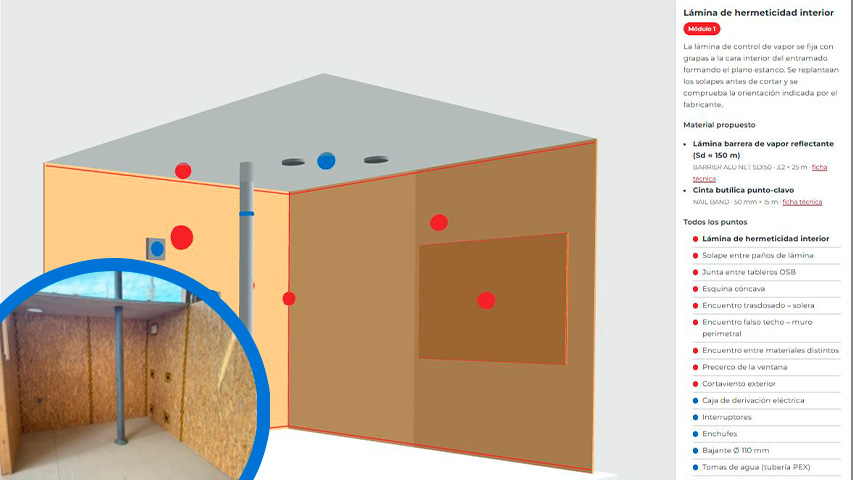
The pilot run of the Construction Blueprint 2 airtightness course concluded on 9 October in Villanueva de Gállego. Over the course of five weeks, the students built their own light-frame timber structures and practised dealing with the same joints and service penetrations they will encounter on site, using an interactive 3D model to identify critical points in the building envelope.
It is one thing to understand the theory of airtightness and quite another to achieve a continuous seal with one’s own hands. During the pilot course ‘Applying insulating strips to prevent air exchange between the exterior and interior via suspended ceilings and insulating cladding’, the students faced precisely this challenge: sealing the joints between different materials and then checking whether the result achieved its objective.
The Aragón Regional Council of the Construction Labour Foundation (FLC) has concluded this practical training on airtightness of the building envelope, as part of Construction Blueprint 2, the Strategic Alliance for Skills Development under the Pact for Skills in the construction sector.
Five weeks, two modules and a unit built from scratch
The course was designed to last approximately 8 hours. During the pilot phase, it proved necessary to extend the scope of the work to include the assembly of the light timber frame (OSB3) panel boxes on which the practical exercises were carried out – a decision that proved to be one of the highlights of the experience: the students were not provided with a finished structure, but instead built the very structure they then had to seal.
The assembly took place in mid-September, and the theoretical and practical sessions for the two modules were held between 17 September and 9 October, the date of the final review and assessment session by the students and trainers. Eleven students took part in the pilot scheme, organised into teams of two or three, with one team per box.
The training was delivered face-to-face, in classrooms and workshops, with access to an online platform containing all the theoretical content.
From theory to the critical point: an interactive 3D model
The course was developed by Ana González and Teresa Sandiumenge, from the headquarters of the Construction Labour Foundation, and was delivered by trainers from the Aragon Regional Council: Juan Lobaco, Lourdes Carreras, Óscar Llorente and Javier Buil.
As an innovative feature, the team has developed an interactive three-dimensional model of the units in which students can rotate the model, locate each critical point on the building envelope and check, for each one, what type of solution is appropriate and why. The model distinguishes between linear junctions between wall surfaces and service penetrations – the two main sections into which the course is organised – and is available upon registration on the course platform.
Educational ‘boxes’ featuring real-life construction site problems
Each of the four boxes, constructed from lightweight timber-framed panels (OSB3), was equipped with the elements that cause the most headaches on a building site: wooden frame, junction box, switches, sockets, washbasin drain, water outlets with PEX pipework, downpipe and light fittings. Using these, the students tackled the most common joints in the building envelope and service penetrations using sealing tapes, strips and membranes.
The assessment was not limited to the outcome of the waterproofing. The assessment grid used by the trainers covers ten learning outcomes per module, where, in addition to the technical aspects, other factors are assessed, such as the tidiness and cleanliness of the workstation, end-of-day procedures, teamwork, adherence to health and safety instructions, and the management of waste generated. Impeccable sealing with a messy workstation does not pass, just as it would not pass on a building site.
Pilot programme results
All eleven trainees passed the training course, which was assessed through theoretical tests and the observation checklists completed during the practical sessions.
When asked about their level of satisfaction during the final session, the trainees agreed on two points: that putting what they had learnt in the theory into practice is crucial for consolidating their learning, and that having access to the online platform with the theoretical content allowed them to review on their own anything that had not been clear to them in class.
What those who attended the workshop had to say
“Taking part in this project on sealing and tape installation has enabled us to learn about materials and application techniques that, until now, we’d only seen in photographs. Assembling the box first and sealing it afterwards changes the way you understand it: you see where the problem lies before it’s explained to you. And it’s a field that’s very important right now, because energy efficiency and cost savings are being discussed on every building site.
“The construction industry today needs professionals who are trained and equipped to adapt to a labour market where new construction systems are emerging every day. Taking part in these projects enables us to update our teaching staff’s knowledge and enhance our students’ professional skills. What interests me most about this pilot scheme is that the student hasn’t learnt how to install a specific product, but rather how to read a technical data sheet, choose the right solution for the situation at hand and justify why. That skill will serve them well with whatever material they’re given in ten years’ time.”